What Is Two-Phase Cooling?
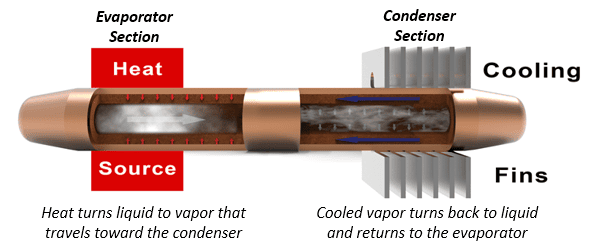
Two-phase cooling uses the evaporation and condensation of a working fluid to spread and transport heat with low temperature rise. It is used when heat is too concentrated, too far from the rejection point, or too constrained by geometry for conduction or conventional cooling approaches alone.
In electronics cooling, two-phase devices such as heat pipes, vapor chambers, and thermosyphons are typically used between the heat source and the final heat rejection method. They move heat to where it can be rejected more effectively – through a heat sink, cold plate, chassis, airflow path, or liquid loop.
Where Two-Phase Fits in the Thermal Stack
Two-phase cooling is not a complete thermal solution on its own. It solves two specific problems: heat spreading and heat transport. Heat spreading moves thermal energy away from a concentrated source, like a processor die or RF module, across a larger surface area to reduce peak temperatures. Heat transport moves that energy from the source to a remote rejection point, such as a fin stack or cold plate.
What two-phase heat transfer does not do is reject heat to ambient. That step still requires a downstream mechanism: forced air across a fin array, a liquid-cooled cold plate, or a conduction path to a chassis wall. Two-phase devices are the high-conductivity link between the heat source and whatever rejection method the system uses. Engineers should think of heat pipes, vapor chambers, and thermosiphons as a thermal bridge, not a replacement for the rest of the cooling architecture.
This distinction matters at the design stage. Sizing a vapor chamber or heat pipe assembly correctly depends on knowing the rejection-side boundary condition. The two elements are interdependent, and both must be designed together.
When Two-Phase Cooling is Considered
Two-phase cooling is typically considered when local heat flux, distance, temperature uniformity, or packaging constraints limit the effectiveness of solid metal conduction or conventional cooling alone.
- High heat flux: Power density in the range of 20 to 50 W/cm² or higher, where solid metal bases cannot spread heat fast enough to prevent hot spots.
- Hotspot-driven design: A localized heat source with a much smaller area than the available rejection surface, where spreading resistance is the dominant thermal bottleneck.
- Tight temperature uniformity: Multiple sources requiring consistent temperatures across an array, where single-phase gradients would produce unacceptable variation.
- Spatial constraints: Insufficient fin area or airflow for air cooling alone, requiring heat to be moved to a remote rejection zone.
- Passive operation: Applications where long service life, no moving parts, and zero power draw are requirements, such as sealed defense electronics or space platforms.
Types of Two-Phase Cooling Solutions
Passive Two-Phase Cooling (Celsia’s Core Capabilities)
The following device types are what we design and manufacture. All are passive, sealed, and require no external power to operate.
Heat Pipes
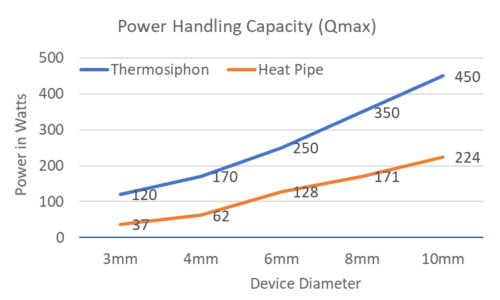
Heat pipes are sealed devices containing a working fluid and a wick structure inside a metal envelope. They transfer heat through evaporation at the source and condensation at the sink, with the wick returning condensate via capillary action. Typical heat pipes handle 10 to 500 watts, with high-performance sintered-wick designs exceeding 1 kW. Their ability to be bent or flattened makes them adaptable to complex mechanical envelopes.
Vapor Chambers
Vapor chambers extend heat pipe principles into a flat, planar geometry, spreading heat two-dimensionally from a localized source to a larger base area. They are particularly effective at eliminating hot spots in high-power CPUs, GPUs, and RF devices, and commonly replace solid metal base plates in high-performance heat sink assemblies.
Thermosiphons
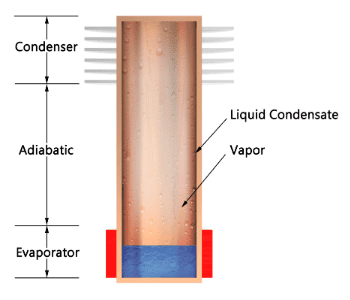
Thermosiphons operate on the same two-phase cycle as heat pipes but use gravity rather than capillary action to return condensate to the evaporator. The absence of a wick simplifies manufacturing and reduces cost. They are well-suited for industrial and telecommunications applications where the condenser is reliably positioned above the evaporator.

Loop Heat Pipes
Loop heat pipes separate the evaporator and condenser into distinct components connected by fluid lines, allowing complex routing over longer distances. This makes them suitable for aerospace and defense applications where heat must travel around structural obstacles while maintaining passive, reliable operation.
Active Two-Phase Cooling (Industry Context)
The following are active two-phase technologies used across the industry. Celsia does not design or manufacture these systems. They appear here because thermal engineers researching two-phase cooling are likely working across the full spectrum of available approaches.
Pumped Two-Phase Cooling
Pumped two-phase cooling uses a mechanical pump to circulate subcooled liquid to evaporators, where partial vaporization occurs before the vapor is routed to a condenser and the liquid returned. Forced circulation allows higher power densities and more precise flow control than passive devices, at the cost of added mechanical complexity and pump maintenance. These systems are used in aerospace thermal control loops and high-power industrial equipment.
Two-Phase Immersion Cooling
Two-phase immersion cooling submerges electronics directly in dielectric fluid, which boils at around 50°C and condenses on a heat exchanger above the tank, returning liquid to the bath passively. It is used in AI and HPC data centers where rack power densities exceed what air cooling can manage. These are infrastructure-scale systems, distinct from the component-level passive devices Celsia produces.
Refrigeration-Based Cooling
Vapor-compression refrigeration uses a compressor, condenser, and expansion valve to achieve sub-ambient cooling. It is used in applications requiring temperatures below ambient, such as certain semiconductor test equipment and specialized defense systems.
Performance vs. Single-Phase Cooling
Compared with solid copper or aluminum bases, two-phase devices can provide much higher effective thermal conductivity because vapor transport moves heat across the device with relatively low temperature drop. This is especially valuable when heat must spread from a small source to a larger heat sink footprint.
Compared with single-phase liquid cooling, the advantage is not always bulk heat removal. Single-phase liquid can reject large heat loads when flow rate, pressure drop, and cold plate area are available. Two-phase devices are often selected because they improve spreading, reduce hot spots, or move heat passively to a better rejection location.
Two-Phase Thermal Management Applications
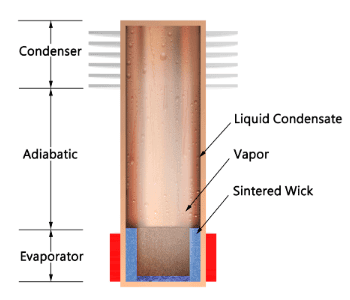
Two-phase thermal management addresses spreading and transport problems across a range of industries where heat flux, envelope constraints, or reliability requirements exceed what conventional air cooling can provide.
Aerospace and Defense
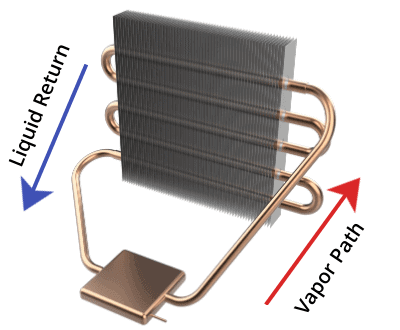
Loop heat pipes are used in satellites and spacecraft to route heat from sun-facing electronics to shaded radiators, operating reliably across extreme temperature cycles and in zero gravity. Defense electronics in aircraft, ground vehicles, and naval platforms use ruggedized heat pipe and vapor chamber assemblies built to MIL-STD environmental requirements, where sealed passive construction is a reliability requirement, not a preference.
High Heat Flux Electronics
When power density at the die or module level exceeds what solid metal can spread, vapor chambers address the gap directly. At the die level, vapor chambers reduce hot-spot temperatures in advanced processor and GPU packages, enabling chip architectures that would be thermally limited by solid copper or aluminum bases. The near-isothermal behavior of phase change maintains more uniform temperatures across the die face than any solid conductor of equivalent geometry.
RF, Radar & Power Electronics
High-power RF amplifiers, phased array radar transmit/receive modules, and power electronics present localized heat flux problems in space-constrained enclosures. Custom vapor chamber and heat pipe assemblies are used to spread heat from the module footprint to a larger fin array or chassis interface, managing junction temperatures within the tight budgets these components require. This is one of the primary application areas we serve.
High-Performance Computing
In HPC, two-phase cooling addresses spreading and transport at the component level across a range of thermal sources within a compute node:
- Processor and GPU modules
- Memory arrays
- Power delivery components
- I/O devices
- System power supplies
- Optical interconnect modules
At each of these locations, the challenge is moving heat from a concentrated source to a surface that a liquid or air cooling system can reject from. Heat pipes and vapor chambers handle the spreading and transport portion; the rejection step remains with the rack-level cooling infrastructure.
Design Considerations
- Heat flux mapping: Evaporator sizing must be based on accurate source heat flux maps to avoid film boiling and the sharp drop in heat transfer coefficients that follows.
- Interface resistance: Contact between the two-phase device and the heat source must be controlled for flatness and bond line thickness, as interface resistance often rivals spreading resistance in its effect on junction temperature.
- Orientation: Capillary-driven devices have orientation-dependent performance limits that must be evaluated against worst-case installation and operational orientations.
- Fluid compatibility: Working fluid purity and enclosure material compatibility must be validated to prevent non-condensable gas generation, which degrades performance over time.
For detailed engineering design guidance, including thermal modeling, performance limits, and system integration approaches, see our [PLACEHOLDER: Two-Phase Cooling Design Guide — link to be added when page is live]. For heat sink design fundamentals, visit Heat Sink Design Fundamentals.
Celsia’s Two-Phase Cooling Capabilities
Two-phase thermal management is the core of what we do. The majority of our programs involve passive phase-change designs, backed by 30+ active patents and thousands of custom assemblies delivered across aerospace, defense, telecom, and industrial markets. Our engineering team works directly with customers from initial thermal analysis through prototype testing and production.
We hold ISO 9001:2015 certification and ITAR registration, with 100% testing of every two-phase device prior to shipment. Our in-house capabilities cover:
- Sintered copper heat pipes (custom wall thickness, wick geometry, and fluid loading)
- 1-piece and 2-piece vapor chambers
- Thermosiphons
- Phase change material heat sinks
- Complete thermal assemblies with fin stacks, mounting hardware, and thermal interface materials
Whether you are specifying a two-phase cooling device for the first time or refining an existing design, our engineering team can help you select the right approach and work through the tradeoffs. Contact us to discuss your application.